|

Glasgow (population, 2001,
578,700) is Scotland’s largest city. It forms part of the
metropolis of Clydeside, which is composed of a large number
of urban areas, including Clydebank, Paisley, Kilmarnock, and
Hamilton. This region is the main industrial and commercial
center in Scotland. Edinburgh
(449,000) is the capital of Scotland and also the
country’s major administrative and financial center. The city
is Scotland’s main tourist destination and hosts the Edinburgh
International Festival, the largest annual arts festival in
the United Kingdom.
Other major
cities are Aberdeen (211,300), a center for oil production and
distribution, and Dundee (150,250).
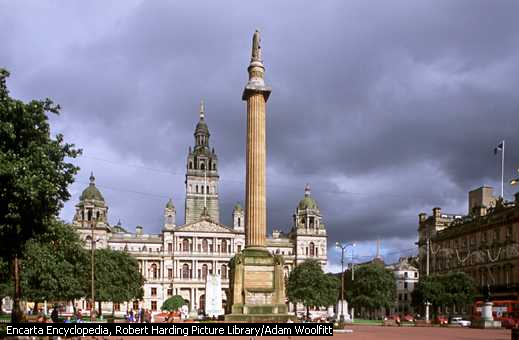
George Square, Glasgow
George Square lies at the heart of Glasgow, Scotland, a
bustling seaport and industrial center. The City Chambers
building, shown in the background, is constructed in the
Italian Renaissance style, which was popular in the 19th
century. In the foreground is a column topped by a statue of
novelist and poet Sir Walter Scott.
Robert Harding Picture Library/Adam Woolfitt
Glasgow, city,
western Scotland, on the Clyde River. Glasgow is the largest
city and leading industrial center of Scotland. It has an
excellent harbor and modern port facilities. Major imports
include petroleum, grain, and timber; exports are largely
manufactured goods. The city is located near important
coalfields and is a major steel-producing center. Other
industries include shipbuilding and printing and the manufacture
of textiles, carpets, aircraft engines, electronic equipment,
chemicals, alcoholic beverages, and processed foods.
Relatively few
buildings in Glasgow predate the 18th century; the most
prominent of these are Saint Mungo's Cathedral (begun about 1136
and completed in the mid-15th century) and Provand's Lordship
(circa 1471), the city's oldest house. Glasgow is an educational
center; the University of Glasgow (1451), the University of
Strathclyde (1796), the Royal Scottish Academy of Music and
Drama (1847), Glasgow School of Art (1845), and several
technical colleges are located here. The extensive collections
of the Glasgow Art Gallery and Museum are among the finest in
Britain. Also of note in the city are the Hunterian Museum
(1807), the botanic gardens, and a zoo.
Glasgow grew around a
church built in the mid-6th century by Saint Kentigern (also
called Saint Mungo), apostle to the Scots. In 1116 the town's
church was rebuilt for the reconstituted episcopal see of
Glasgow. The great commercial growth of the community dates from
the union of Scotland with England in 1707. Glasgow obtained a
large share of the American commerce and soon became a center of
the tobacco trade. The river was dredged to accommodate seagoing
vessels. The tobacco trade ceased as a result of the American
Revolution and was subsequently supplanted by cotton textile
manufacture and the sugar trade with the West Indies. In the
early 19th century, Glasgow began its growth as a major iron
founding and shipbuilding center. During World War II
(1939-1945) the city suffered some damage from German bombing.
Slum clearance and urban redevelopment projects have been
undertaken since the war. In 1974 Glasgow became the
administrative center of the Strathclyde Region. In the 1996
reorganization of local government in Scotland, Glasgow became a
unitary authority. Population (2001 estimate) 578,700.
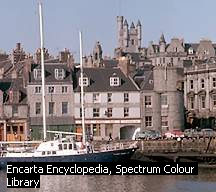
Aberdeen, Scotland
Aberdeen is located in northern Scotland, on the North Sea at
the mouth of the River Dee. It is an industrial center,
especially for petroleum companies operating in the North Sea.
Aberdeen is also known as the Granite City for its many
granite buildings.
Spectrum Colour Library
Aberdeen
(Scotland), city in northeastern
Scotland, situated on the North Sea at the mouths of the
Dee and Don rivers. Aberdeen is the third largest city in
Scotland, after Glasgow and Edinburgh, and is the principal
industrial center of northern Scotland. It is also an important
seaport and the country's largest fishing port. Aberdeen's
harbor facilities were improved in the 1970s, and the city has
become the major service center for the North Sea petroleum
industry. Manufactures include chemicals, machinery, textiles,
and paper. Aberdeen is a tourist resort known for its sandy
beaches. It is popularly known as the Granite City because many
of its buildings are constructed of local granite, the city's
chief export. Points of interest include the Church of Saint
Nicholas (founded in the 12th century), the largest parish
church in Scotland; the Cathedral of Saint Machar (begun 15th
century); and the University of Aberdeen, formed in 1860 from
the merger of the Roman Catholic King's College (1495) and the
Protestant Marischal College (1593). The city also has several
museums, an art gallery, and colleges of agriculture and
technology. Aberdeen was made a royal burgh in 1179. In 1337 the
town and its cathedral were burned by Edward III,
king of England. The harbor was improved in the late 18th
century, after which Aberdeen developed as a fishing port.
Between 1974 and 1996, Aberdeen was the administrative center of
the former Grampian Region. In the 1996 reorganization of local
government, Aberdeen City was made a unitary authority.
Population 211,300 (2001 estimate).
Dundee,
city, eastern Scotland, on the Firth of Tay, near the North Sea.
Dundee is the second most important industrial center of
Scotland. It is also a seaport receiving a large inward traffic
of petroleum products and handling service vessels for North Sea
oil fields. Among the many manufactures are textiles, rope,
carpet, plastic, light engineering products, and processed
foods; the printing and publishing industry is also important. A
local landmark is City Churches, which houses three separate
churches under one roof. The city has a municipal museum and art
gallery and is the seat of the University of Dundee (1881);
colleges of art, technology, and commerce are also located here.
Dundee was made a royal burgh by the Scottish king William the
Lion in 1190 and quickly became a leading town of Scotland. It
suffered greatly from English raids, notably in 1296, 1385,
1547, and 1651. Whaling became an important industry here in the
late 1700s. After the 1830s Dundee developed as a major
jute-processing center. In 1974 it became the administrative
center of the Tayside Region, and in the 1996
reorganization of local government became a unitary authority.
Population (1996 estimate) 150,250.
Microsoft ® Encarta ® 2006. © 1993-2005
Microsoft Corporation. All rights reserved.
|